We help enterprises
innovate faster.
Let employees build what they need. Make adoption visible. The best tools rise to the top — not because a committee picked them, but because people chose to use them.
Bottom-up innovation, made visible
Your employees already know what tools they need. Give them the platform to build them, make adoption visible, and let internal motivation drive what gets invested in.
Make adoption visible
See which tools employees actually choose to use. When adoption is visible, the data tells you what works.
Harness internal drive
Employees build what they need because they're motivated to solve their own problems. That intrinsic drive produces better tools than any mandate.
Steer with visibility
See the full portfolio — what's being built, what's adopted, what's stalling. Leadership steers by visibility, not by approving every project.
Most of the delay is conversation
Take a request that is about as small as they come. Operations wants to see which orders are stuck waiting on a supplier. Nobody in this story does anything wrong, and it still takes nine weeks.
The usual route
9 weeks- Day 1
Operations lead
Writes a note. Orders that are waiting on a supplier are invisible until someone phones the warehouse.
- Day 4
Product owner
Turns the note into a ticket, guesses at the fields, and puts it in the backlog behind twelve other things.
- Week 3
Developer
Picks it up and reads a description written three weeks ago by someone who is now on leave.
- Week 4
Both
Half an hour on a call to settle two questions the ticket did not answer. Waiting means something different in each department.
- Week 6
Operations lead
Sees the first version and finds that the column that matters is not on it. Files a follow-up ticket.
- Week 9
Developer
Ships the column. The process it was written for has moved on since the note.
The same request on Shaep
2 days- Hour 1
Operations lead
Describes the view in the browser editor. The AI builds it against the real order data in a dev environment.
- Hour 2
Operations lead
Spots the missing column while looking at the screen, asks for it, and has it a minute later.
- Afternoon
The team
Opens the dev URL, clicks through it together, and says what is wrong while the thing is in front of them.
- Day 2
Developer
Reviews the code, the test run and the security scan, then approves the release to production.
The coding was never the slow part. What disappears here is the row of handovers between people who each hold half of the problem, along with all the waiting in between them.
What actually changes
Nobody has to specify it perfectly
A written request carries only what the requester thought to write down. The rest gets recovered later, in questions. When the app takes shape in front of them, the detail they forgot surfaces on screen in the first hour rather than in week six.
Feedback lands on the running app
Reviewers open a dev URL and react to software they can click, so a comment points at a screen instead of at a paragraph. Nobody has to work out which screenshot in the thread the complaint was about.
Being wrong gets cheap
When a change costs six weeks, people write long defensive documents to avoid a second round, and that writing is most of the delay. When a change costs an hour, showing a rough version early is simply the sensible move.
Developers review instead of translate
Your engineers stop acting as interpreters between departments. They read the diff, the pipeline output and the scan results, and they still hold the approval on anything that reaches production.
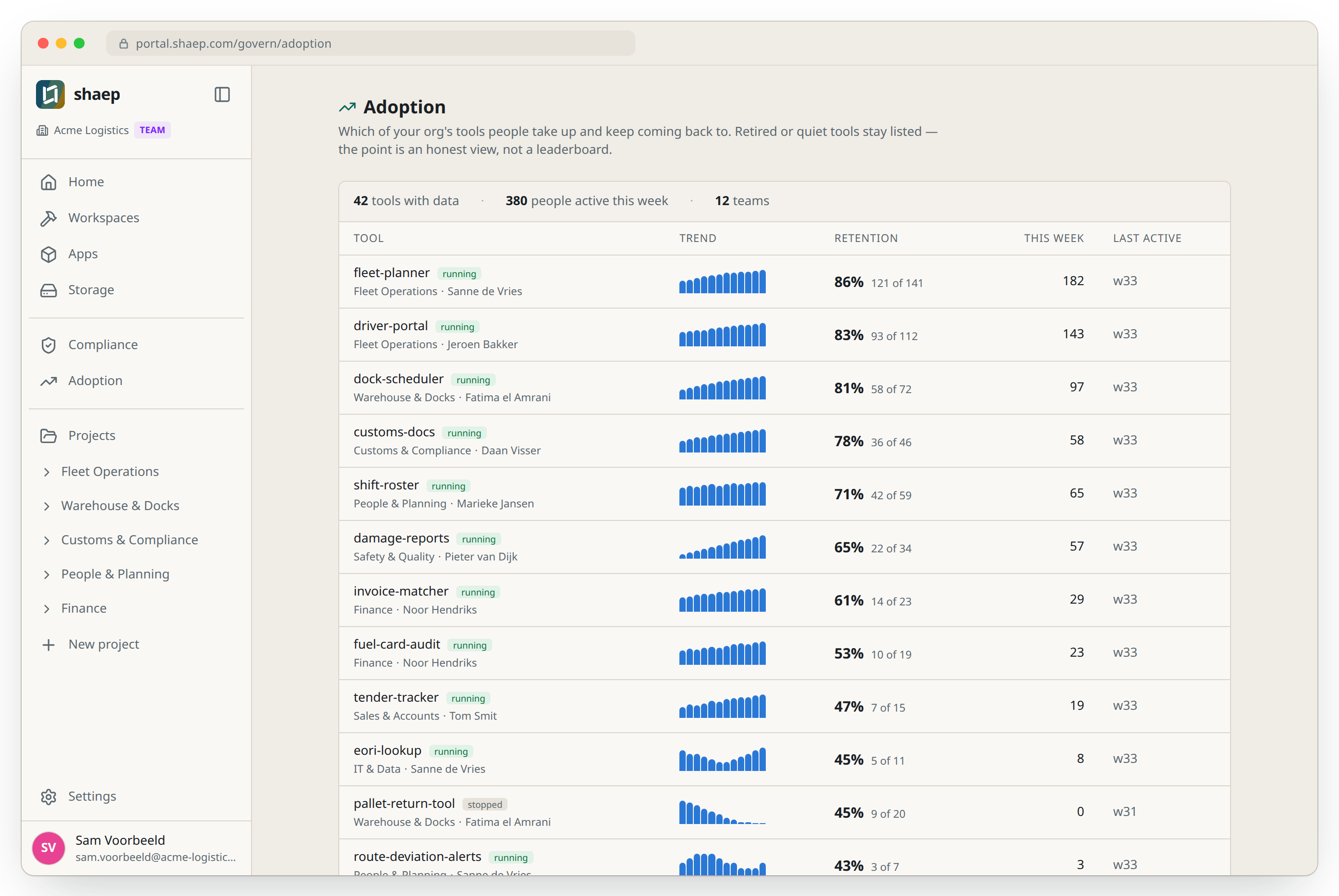
Track adoption, steer by visibility
See which internal apps get used — by whom, how often, and how usage trends over time. Surface what works before the quarterly review. Kill what doesn't before it becomes a sunk cost.
- Usage metrics per app and team
- Adoption trends over time
- Resource allocation signals
- Portfolio-wide visibility
Built for every team
Not just developers. Product, marketing, sales, legal — everyone who needs software built can ship it themselves.
Product managers
- Ship features without filing tickets
- Track adoption — see what's used
- Connect to real data for credible demos
Marketers
- Launch landing pages in minutes
- A/B test without dev support
- On-brand with shared design systems
Sales & Support
- Build demos that actually work
- Create support tools in-house
- Client portals under custom domains
Legal & Finance
- Audit trails on every release
- Budget visibility per team and app
- EU-sovereign — no Cloud Act exposure
Production-grade from day one
Every app ships with a professional pipeline. CI/CD, testing, security scanning, compliance — without a platform team setting it up.
CI/CD on every push
Every commit triggers build, test, scan, and deploy. No Jenkins, no config.
Security scanning
Automated vulnerability scanning in the pipeline. Catch issues before they ship.
Dev / prod separation
Isolated environments so testing never touches production data or users.
Audit trails
Who changed what, when, and why. On every release, every plan.
AI agents with identity
Deploy autonomous agents with scoped permissions and any AI model.
SSO & access control
SAML, OIDC, role-based permissions. Enterprise identity providers work out of the box.
Whitelabel for agencies
Lovable takes your work away. Shaep gives it back. Run the platform under your own brand, spin up client environments, own the relationship.
- Your brand, your platform
- Per-client isolated environments
- Coding support included
Frequently asked questions
What do you mean by bottom-up innovation? +
Employees closest to the problem build the solution — because they're motivated to fix their own pain. Shaep gives them the platform to do it without IT tickets or dev resources. When you make adoption visible, the best tools surface naturally.
How does adoption visibility work? +
The platform tracks which apps are used, by whom, and how usage trends over time. This data is visible to leadership and creates natural resource allocation signals — tools that employees choose to use get investment.
Does this cut our developers out of the loop? +
No, it moves them later into it. The person with the problem builds and iterates in a dev environment, and a developer reviews the code, the test run and the security scan before anything reaches production. Approval, audit trail and access control stay exactly where they are today. What goes away is the week an engineer spends turning a ticket into an understanding of the problem.
Can we whitelabel Shaep for our clients? +
Yes. Agencies can run Shaep under their own brand with per-client environments, isolated deployments, and custom domains. You own the client relationship.
How is Shaep different from Lovable or Bolt? +
They stop at "here's your app." Shaep continues: CI/CD pipeline, security scanning, adoption tracking, compliance. What you build is production-grade from the start.
What security certifications do you have? +
GDPR compliant by default, ISO 27001 certification in progress. Infrastructure runs on EU-owned providers. We're happy to provide a DPA.
What support do enterprise customers get? +
Priority platform support, onboarding assistance, compliance review support, and direct access to the product team. Custom support contracts available.